American Academy of Pediatric DentistryAmerican Academy of Pediatric Dentistry

SITE SEARCH
Advanced Search

 
Find a Pediatric DentistGo HomeContact UsSite MapCopyright and Disclaimers
 
Members OnlyLog In

  Home

  About AAPD

  Join AAPD

  Policies and Guidelines

  AAPD Journals

  Press Kit

  AAPD Meetings & Events

  Healthy Smiles,
  Healthy Children


  Dental Health Resources

  Residency Programs

  Parent Resource Center

  Head Start Dental Home
  Initiative


  Online Store

  American Board of
  Pediatric Dentistry


  College of Diplomates


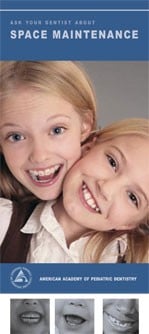
Space Maintenance

Q: Why do children lose their baby teeth?

A: A baby tooth usually stays in until a permanent tooth underneath pushes it out and takes its place. Unfortunately, some children lose a baby tooth too soon. A tooth might be knocked out accidentally or removed because of dental disease. When a tooth is lost too early, your pediatric dentist may recommend a space maintainer to prevent future space loss and dental problems.

Q: Why all the fuss? Baby teeth fall out eventually on their own!

A: Baby teeth are important to your child's present and future dental health. They encourage normal development of the jaw bones and muscles. They save space for the permanent teeth and guide them into position. Remember: Some baby teeth are not replaced until a child is 12 or 14 years old.

Q: How does a lost baby tooth cause problems for permanent teeth?

A: If a baby tooth is lost too soon, the teeth beside it may tilt or drift into the empty space. Teeth in the other jaw may move up or down to fill the gap. When adjacent teeth shift into the empty space, they create a lack of space in the jaw for the permanent teeth. So, permanent teeth are crowded and come in crooked. If left untreated, the condition may require extensive orthodontic treatment.

Q: What are space maintainers?

A: Space maintainers are appliances made of metal or plastic that are custom fit to your child's mouth. They are small and unobtrusive in appearance. Most children easily adjust to them after the first few days.

Q: How does a space maintainer help?

A: Space maintainers hold open the empty space left by a lost tooth. They steady the remaining teeth, preventing movement until the permanent tooth takes its natural position in the jaw. It's more affordable -- and easier on your child -- to keep teeth in normal positions with a space maintainer than to move them back in place with orthodontic treatment.

Q: What special care do space maintainers need?

A: Pediatric dentists have four rules for space maintainer care. First, avoid sticky sweets or chewing gum. Second, don't tug or push on the space maintainer with your fingers or tongue. Third, keep it clean with conscientious brushing and flossing. Fourth, continue regular dental visits.


Copyright © 2002-2008 American Academy of Pediatric Dentistry. All Rights Reserved.
Website Designed by AmericanEagle.com, Inc.


Copyright © 2002-2008 American Academy of Pediatric Dentistry. All Rights Reserved.
Website Designed by AmericanEagle.com, Inc.